
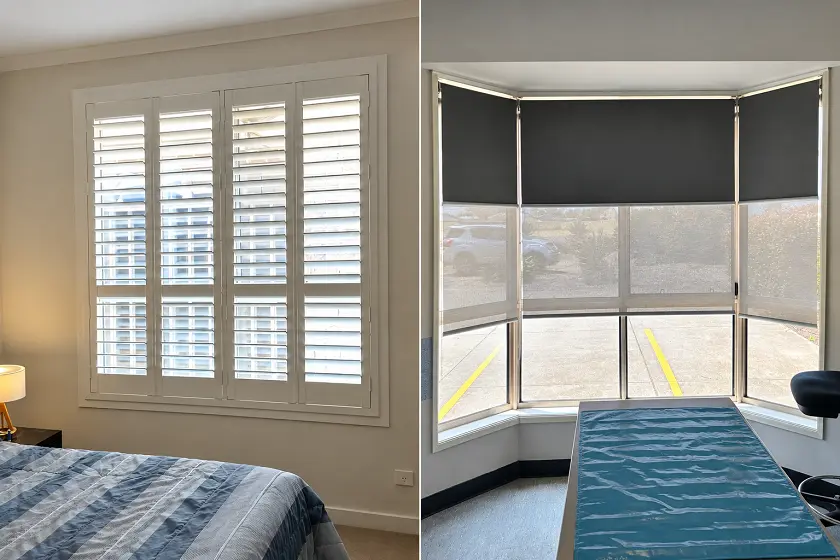
We hear this question at least once a week. A homeowner is renovating a bedroom, a living room, or the whole house. They want something that looks good, controls the light properly, and lasts. They’ve narrowed it down to two options: indoor blinds or plantation shutters. Both are on display at every home show. Both look great in the photos. And the price difference is significant enough that they want to be sure they’re spending the money in the right place.
At Shutter Plus SA we sell and install both products across Adelaide. We’re not going to push you toward the more expensive option to pad the invoice. The honest answer is that the right choice depends on four things: the room, the orientation, your priorities, and your budget. And in some rooms, the cheaper option is genuinely the better one.
This guide covers everything you need to make a confident decision – real performance data, honest cost comparisons, and a room-by-room guide that tells you which product we’d actually recommend in your situation.
Key Takeaway: Neither product is universally better. Plantation shutters excel on aesthetics, longevity, and resale appeal. Indoor blinds win on cost, flexibility, and specific functional needs like blackout and motorisation. The best Adelaide homes often use both – plantation shutters in living areas and high-visibility rooms, indoor blinds in bedrooms and functional spaces.
What Are We Actually Comparing?
Indoor blinds
Indoor blinds cover a wide range of products – roller blinds, roman blinds, cellular (honeycomb) blinds, venetian blinds, and panel blinds. They share the same basic principle: a fabric or slatted material that can be raised, lowered, or adjusted to control light and privacy. They mount inside or just above the window frame and roll, fold, or stack when raised.
The range within “indoor blinds” is enormous – from basic $80 roller blinds to custom-made double-cell cellular blinds with motorised cassette systems. When comparing to plantation shutters, we’re talking about quality mid-to-upper-range indoor blinds in Adelaide, not the cheapest off-the-shelf option.
Plantation shutters
Plantation shutters are interior window shutters with wide adjustable horizontal louvres mounted in a solid frame that fits inside or around the window opening. They fold back like bi-fold doors when you want them fully open. They come in PVC (often called “ABS” or “polymer”), basswood timber, and aluminium for wet areas.
Quality plantation shutters in Adelaide are a permanent installation – fixed to the window frame and designed to stay for the life of the home. They’re a different category of product to blinds in terms of installation method, material, and long-term expectation.
Light Control – Who Does It Better?
Plantation shutters: adjustable, but not blackout
Plantation shutters give you continuous light control through louvre adjustment – tilt them fully closed for maximum privacy and minimum light, open them partially for soft diffused light, or fold the panel back entirely for full light. That flexibility is one of the most-cited reasons people choose them.
What they don’t provide is true blackout. Even with louvres fully closed, light enters through the gaps between louvres and around the frame perimeter. For a bedroom where complete darkness is needed – shift workers, young children, or anyone who sleeps during the day – plantation shutters alone won’t deliver it.
Indoor blinds: full blackout available
Block-out roller blinds with a cassette top rail and side channels create genuine blackout – no light around the edges, no light through the fabric. For a bedroom that needs to be dark at 7am in Adelaide’s summer when the sun is already up and strong, a well-fitted block-out blind outperforms plantation shutters for this specific purpose.
For light filtering without full darkness, sheer and sunscreen roller blinds or light-filtering roman blinds give soft, even diffusion. The range of light control options across the indoor blind category is wider than plantation shutters.
Key Takeaway: For complete blackout – shift workers, young children’s bedrooms, media rooms – indoor blinds win. For adjustable light control with ventilation in living areas, plantation shutters are difficult to beat. In bedrooms where both are priorities, some Adelaide homeowners install plantation shutters with a block-out blind behind them, though this adds cost.
Heat Performance in Adelaide – The Honest Picture
Adelaide’s heat is the question underneath every window covering decision. Neither indoor blinds nor plantation shutters are external products – both sit inside the window frame, which means they’re intercepting heat after it has passed through the glass.
Plantation shutters
With louvres fully closed, plantation shutters create a sealed air gap between the glass and the room. That air gap provides modest insulating benefit – roughly 20–35% heat reduction compared to uncovered glass on a standard Adelaide summer day. On an extreme 43°C afternoon with the west sun punching through the glass, the performance is limited. The glass is hot, the air in the gap heats up, and that heat enters the room.
Indoor blinds – cellular leads
Double-cell cellular (honeycomb) blinds are the best-performing interior product for heat management in Adelaide – reducing heat gain by 40–60% through the insulating air pockets trapped in the cellular structure. A well-fitted double-cell cellular blind outperforms plantation shutters on pure thermal performance. Quality block-out roller blinds with reflective backing achieve 30–45% heat reduction.
Standard roman blinds and venetian blinds perform similarly to plantation shutters or slightly worse, depending on fabric weight and slat material.
Pro Tip: For Adelaide’s most heat-exposed rooms – west-facing bedrooms, north-facing living areas – neither product is the full answer. The best heat solution is an external roller shutter or outdoor blind that stops heat before it reaches the glass. Interior products (both blinds and shutters) are a supplement to that, not a substitute. If you’re installing interior coverings without external products on heat-critical windows, cellular blinds deliver the best available interior thermal performance.
Aesthetics – Where Plantation Shutters Pull Ahead
This is where plantation shutters consistently win. There’s a reason they appear in the majority of Adelaide real estate listings for higher-end properties and feature heavily in every home renovation magazine.
Plantation shutters have a timeless, architectural quality. They look like they belong to the house rather than something hung on it. In Adelaide’s established suburbs – Burnside, Norwood, Unley, Walkerville, Glenelg – plantation shutters complement both heritage homes and contemporary renovations in a way that most blinds simply don’t.
Quality indoor blinds can look elegant – a well-chosen roman blind in a neutral linen fabric reads as considered and intentional. But even the best roller blind doesn’t carry the same visual weight as a set of plantation shutters. If the way a room looks and photographs is a significant part of the decision, shutters are the stronger choice.
Resale value and buyer appeal
Adelaide’s real estate market consistently treats plantation shutters as a positive feature. They’re mentioned in property descriptions, photographed prominently, and perceived by buyers as an indicator of quality renovation. Indoor blinds in Adelaide are rarely mentioned in property listings and are considered a standard inclusion rather than a feature.
For homeowners who are renovating with resale in mind – or who simply want their home to present well – plantation shutters in the main living areas and master bedroom are a stronger investment from a perception standpoint.
Durability and Longevity – What Lasts Longer in Adelaide?
Plantation shutters
Quality plantation shutters – whether PVC or basswood timber – are built to last the life of the home. A properly installed PVC shutter system in Adelaide should last 20–30 years without significant deterioration. The hinges and louvre pivot mechanisms are the components most likely to need attention over time, and they’re serviceable.
Plantation shutters also handle Adelaide’s UV environment well. Quality powder-coated aluminium or UV-stable PVC doesn’t yellow or degrade in the same way that some blind fabrics do under sustained UV exposure. They don’t collect dust in the same way fabric products do, and they’re easy to wipe clean.
Indoor blinds
Lifespan varies significantly by blind type and fabric quality. Quality roller blinds with UV-stable fabric should last 8–12 years in Adelaide conditions. Roman blinds with quality fabric can last 10–15 years. Cellular blinds last 10–15 years. Venetian blinds vary by material – aluminium venetians can last 15+ years but fade; timber venetians 10–15 years.
The weak points for indoor blinds in Adelaide are UV degradation of fabrics (colour fading and fabric weakening), mechanism wear on roller systems with daily use, and cord deterioration. Quality products from reputable suppliers perform significantly better than imported budget options.
| Factor | Indoor Blinds | Plantation Shutters |
| Upfront cost | Lower – $180–$850 per window | Higher – $450–$2,200 per window |
| Lifespan | 8–15 years (fabric dependent) | 20–30 years (PVC or timber) |
| Heat performance | Best: cellular (40–60%); roller block-out (30–45%) | Moderate: 20–35% with louvres closed |
| Blackout available | Yes – block-out roller with cassette | No – light gap around louvres |
| Light adjustability | Good – fully open or fully down | Excellent – continuous louvre adjustment |
| Ventilation with privacy | Not possible – closed is closed | Yes – louvres allow air with privacy |
| Aesthetics | Good to very good (roman, cellular) | Excellent – architectural feature |
| Resale / buyer appeal | Neutral – standard inclusion | Positive – noted feature in listings |
| Motorisation option | Yes – wide range of options | Limited – not commonly motorised |
| Maintenance | Fabric may need replacing; mechanisms serviceable | Minimal – wipe clean; mechanisms long-lasting |
| Best orientation | All – especially functional rooms | South-facing; any room where style is priority |
When Indoor Blinds Give Better Value
- Budget is the primary constraint – quality indoor blinds cost 50–70% less than plantation shutters for the same window coverage
- Blackout is needed – bedrooms for shift workers, young children, or anyone sensitive to light
- Motorisation is a priority – smart home integration, app control, and scheduling are far more readily available for blinds than shutters
- Functional rooms where aesthetics are secondary – home offices, spare bedrooms, laundries, bathrooms
- Rooms with roller shutters on the exterior – when the shutter handles heat and security, the interior blind only needs to manage light and privacy; an expensive plantation shutter is overkill
- Staging a rental property – quality blinds present well, are tenant-proof, and cost significantly less to replace if damaged
- Apartments and strata properties – where budget is tighter and resale value calculations are different to freestanding homes
When Plantation Shutters Give Better Value
- Longevity is the priority – 20–30 year lifespan means a higher upfront cost amortised over a much longer period
- Main living areas and master bedroom in a quality renovation – where aesthetics, perceived value, and buyer appeal justify the premium
- Ventilation with privacy – the ability to tilt louvres for airflow while maintaining privacy is a genuine lifestyle benefit in Adelaide’s climate
- Heritage and period homes – plantation shutters suit Adelaide’s stock of Victorian, Edwardian, and 1920s–50s homes in a way that blinds often don’t
- Renovating to sell in the mid-to-upper price bracket – plantation shutters in the key rooms contribute to the quality perception that supports a higher asking price
- South-facing rooms with no significant heat problem – where the heat performance advantage of cellular blinds is less relevant and aesthetics can take priority
- Windows where you want privacy plus natural light simultaneously – tilted louvres admit light while blocking direct sightlines; no blind can replicate this
Real Adelaide Scenarios – What We’d Recommend
Scenario 1: Three-bedroom family home in Tea Tree Gully, full house renovation, budget $4,000
Recommendation: quality indoor blinds throughout – cellular blinds on west-facing rooms for heat performance, block-out roller blinds in children’s bedrooms, roman or roller blinds in the living room. Total budget fits comfortably. Plantation shutters across the whole house would cost $8,000–$12,000. The budget doesn’t support it.
Scenario 2: Two-bedroom unit in Norwood being renovated for sale, budget flexible
Recommendation: plantation shutters in the main bedroom and living room – these are the rooms that photograph and present in a real estate listing. Quality roller blinds in the second bedroom and bathroom. This captures the resale benefit of plantation shutters in the rooms that matter without paying the premium everywhere.
Scenario 3: New build in Angle Vale, west-facing master bedroom, shift worker
Recommendation: roller shutters on the exterior window (non-negotiable for heat on west-facing rooms in Adelaide’s northern suburbs) plus a block-out cassette roller blind inside. Plantation shutters would cost more and not deliver the blackout needed. The combination of external shutter and internal block-out blind solves every problem this room has.
Not Sure Which Way to Go? We Can Help You Decide
The honest answer to ‘which gives better value’ is: it depends on the room. And the best way to work that out is to look at the actual windows, understand the orientation, and talk through what matters most to you.
At Shutter Plus SA we supply and install both indoor blinds and plantation shutters across Adelaide, the Barossa Valley, Riverland, and the Peninsulas. We also install roller shutters and outdoor blinds – so when we make a recommendation, we’re looking at your whole home, not just one product category. Free measure and quote, no call-out fee, no obligation. Call us on 08 8284 9213, email enquire@shuttersplussa.com.au, or use the contact form at shuttersplussa.com.au.
FAQs
Yes, in key rooms. They offer a premium look, long lifespan, and potential resale appeal. For bedrooms, offices, and functional spaces, quality blinds can be a more cost-effective choice.
Not always. Double-cell honeycomb blinds generally provide better interior heat reduction than plantation shutters. For extreme west-facing heat, external roller shutters are more effective.
Not completely. Light can enter around the louvres and frame. For true blackout, choose a block-out roller blind, or combine one with shutters.
Quality plantation shutters can last around 20–30 years. Most indoor blinds last approximately 8–15 years, depending on the type and quality.
They can enhance the overall look and quality perception of a home, particularly in main living areas and bedrooms. Their appeal is often strongest in higher-end Adelaide properties.
Plantation shutters are generally easier to clean. Their louvres can simply be wiped with a damp cloth, while some fabric blinds require more careful cleaning.
Absolutely. A popular approach is shutters in living areas and the master bedroom, with quality blinds in secondary bedrooms, offices, bathrooms, and other functional spaces.